


A world of professional riqs is now a click away from you. Collection of in-frame tuning mechanism riqs from the best makers, with handmade hammered cymbals. If you are after an instrument with warm popular Arabic or Turkish sound, a tight Tak and deep Dum, you've just found it. Read more...




The Riq, the drum of the Middle East
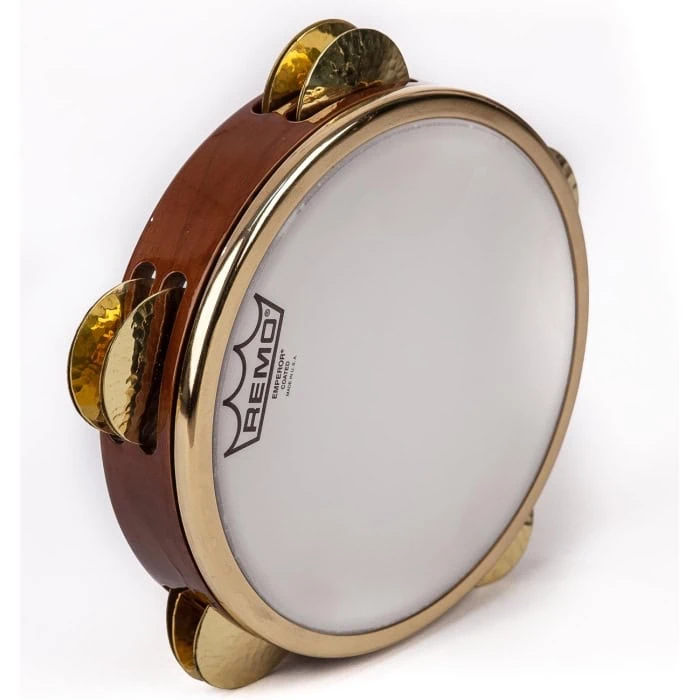
The Riq, also written Riqq, is a frame drum with five pairs of cymbals set into a wooden ring, and in Turkey the same drum is called a tef. Small as it is, it leads: in a classical Arabic orchestra the Riq player keeps the whole ensemble in time, and everyone follows his hands. Choosing one comes down to four things, the skin, the cymbals, the tuning system and the weight. We go through all four below, and if you want the full walkthrough, read our guide on how to choose a professional Riq.
Egyptian or Turkish Riq?
The modern Egyptian factory Riq, the kind Gawharet El Fan makes, runs big, 24 to 25cm across, with external tuning bolts around the frame. They sound strong, but they are heavy, most pass 1kg, and an hour into a wedding gig you'll feel it. The classic Egyptian Riq is a different animal: a light wooden ring with real fish skin glued on, no hardware at all, around 750g. That is the warm sound you hear on the old Cairo recordings. Turkish style Riqs are smaller, 22 to 23cm, lighter, with the tuning hidden inside the frame, and a brighter, sharper tak. Our own Riqs follow the Turkish school: 22cm, frames of walnut, mahogany or cedar, around 850g with brass cymbals and around 950g with bronze, so you can play comfortable over time.
Which skin should I get? Natural vs Synthetic
Real fish skin is the classic Egyptian voice, warm and round, and it answers to the weather: on a humid day it goes soft, and players warm it back to pitch. Goat skin is close, a little drier in sound. If you play on stages, synthetic saves you, it holds pitch in any weather. We carry many models with our own clear and fiber skin heads: the fiber sounds warmer and rounder, the clear is brighter and punchier, and it carries well over other instruments. Some models come with Remo heads, an upgrade for better sound.
The cymbals: stamped or hand-hammered
A Riq carries five pairs of cymbals, zils, ten in total. Factory cymbals are stamped out of sheet metal and ring thin and even. Hand-hammered zils are different: the hammering gives them a less "bright" sound and a more balanced feel, and hammering zils is an ancient tradition, passed down from generation to generation. All our professional models carry hand-hammered cymbals. Brass is the standard, bright and clear. Some of our models carry bronze, which sounds darker and rounder, and adds about 100g to the drum.
Hear the Riq in action:
Tunable or fixed: the three systems
The old way is glued skin, nothing to turn, you tune it with gentle warmth, and it is part of the charm. Egyptian factory Riqs mostly use external tuning, bolts around the outside of the frame, easy to reach, but they add weight and are less comfortable to hold. The third system is internal tuning, invented by Kevork, where the mechanism hides inside the frame: the drum stays slim, the hold stays clean, and you fine tune with a key. All our tunable models tune at 5 points, and on the DELUXE line the system is fully internal, you set the pitch exactly and it stays there.
What a good Riq costs
A serious tunable Riq starts around $169, with external tuning. Between $200 and $350 you find fish skin instruments and hand-hammered cymbals, this is where most working players buy. Concert level runs $400 to $450, and Emin Percussion instruments go up to $600. What raises the price is handwork: hammering cymbals takes hours, and an internal tuning system has to be built into the frame. If you are starting out, an entry tunable model is honestly enough, you can learn every technique on it.
The makers worth knowing
- Kevork - the name behind the internal tuning system, the standard for modern professional Riqs.
- Emin Percussion - respected Turkish style instruments, their concert models are the top of the market.
- Hassan Abdel Maged - the famous fish skin Riqs from Egypt, the sound of the classic recordings. We carried them for years. Since Hassan passed away, his brother Adel continues the family workshop.
- Gawharet El Fan - the biggest name in Egypt, solid instruments, just heavy, most are over 1kg.
- Our own workshop - everything you see on this page is made in our workshops, by our skilled luthiers: Turkish school, hand-hammered cymbals, internal tuning and light frames, because weight is the thing you feel most after the first hour.
For a deeper look at the world's top makers, read our comparison of Nakhle, Cooperman and Kevork Riqs.
Riq, tambourine, tef, daf or bendir?
People call the Riq the Arabic tambourine, and it is a fair short description, but they are not the same tool. A tambourine's jingles hang loose and its head is an afterthought; the Riq has five fixed pairs of cymbals and a playable head, you drum and jingle at once. The tef is simply the Turkish name for the same drum. The Daf is the big Kurdish and Turkish frame drum, deep and washy, with rings inside instead of cymbals. The bendir has no jingles at all, it hums with a snare, and the North African tar is the plainest of the family, just skin and frame. If it is the crisp cymbal talk you are after, the Riq is the one.
Taking care of your Riq
Keep it away from sudden changes of humidity and temperature, that is the main thing. Store it in its padded case, never in a hot car or near a heater. A natural skin that went soft comes back with gentle warmth. The full routine is in our guide, how to take care of your Riq.
Riq questions, answered
A Riq, also written Riqq, is a Middle Eastern frame drum around 22cm across, with a skin head and five pairs of cymbals set in the frame. In Turkey it is called a tef. It is the lead percussion of classical Arabic music.
Five pairs, ten cymbals. On professional Riqs they are hand-hammered, ours come in brass or bronze.
Turkish style runs 22 to 23cm, modern Egyptian style 24 to 25cm. Bigger also means heavier, and over a long set, lighter wins.
Fish skin gives the warm classic sound and needs care in humidity. Synthetic and Remo heads hold their pitch anywhere, best for stage and travel.
Glued heads are tuned with gentle warmth. External systems use bolts around the frame. Internal systems, like our DELUXE line, tune with a key, the cleanest of the three.
Serious tunable models start around $169 (external tuning), professional fish skin and hammered cymbal models run $200 to $350, concert instruments $400 to $600.
Yes, it is one of the friendliest doors into Arabic rhythm, and the dum and tak patterns transfer straight to darbuka and other frame drums. Start on an entry tunable model.
Pick your Riq above, and it ships to your door. Free Worldwide Shipping.